Wednesday, August 23, 2023

Inspired Reading for your OSR game

One of the most enjoyable aspects of developing Demesnes & Domination was researching the late medieval era which is described as 1300-1500 or so. This was important to move the expectations of the game away from the wild-west feel of how Gygax made AD&D feel. Why? Well, if you're going to include a castle in your game it should have purpose and a castle only has purpose as a symbol of power in setting that has some structure of the power dynamics of middle ages otherwise it has no other roll in a game besides saying "I have a stronghold!" The following list is composed of  two sections: one is resources written for an rpg enthusiast audience and the other is non-hobbyist books but are interesting and engaging reads about the late middle ages for the general reader. 
Part 1: Medieval RPG Resources

1) Medieval Demographics Made easy by S. John Ross is a fantastic (and free!) pdf about understanding settlements in the middle ages. city Adventures are oftentimes the most difficult to plan and set up, but this document really helped me understand what to actually expect in a settlement and how to make it feel alive for my players. There is also a website where the content of this pdf was turned into a generator!

2) Fief and Town by Lisa J. Steel are two pdfs I purchased and have used as a primary source of information within the mode of thinking of a referee. Town is a fantastic elaboration on the concepts introduced in Medieval Demographics made Easy and gives plenty of context with famous cities in Western Europe in the middle ages. Fief is extremely good as well, elaborating on the feudal system and the role of a landowner (and their stronghold) within a Western European society. seriously, these books are incredible resources as a general starting place for any hobbyist looking to understand the middle ages but don't know where to start!

3) Codex Guide to the Medieval Baltic: Volume 1 by Codex Integrum is a fantastic source book of North Central Europe around 1450. Its illuminating in how it breaks down cultural, economic, religious, martial, and the mundane within the context of the cultural melting pot of the time. I've purchased this twice, so i can have it on my self and on my phone and I don't regret it. This book is meant to provide support for the publisher's own Codex Integrum game system which look likes a d20 variant with far too much complexity built into this combat to emulate historical fencing using feats and such. While I'm not impressed by their game system per say, the writers know what they are talking about when it comes to the context of the late medieval world around the Baltic region. There is a Volume 2 that really gets into religion and the occult that is also very interesting but isn't available in print so i haven't spent as much time with it as i wish.

Part 2: Medieval Resources for the General Reader

1) The Time Traveler's Guide to Medieval England by Ian Mortimer is a fun and easy read that really gets into the weeds of the humdrum of 14th century England and does a good job at explaining the mindset of the medieval commoner. There is endlessly good bits of information that I have found invaluable to running my own campaigns. This writer has a fun whimsy that feels very British, not just for his topic  but also the terminology and focus on Chaucer and his world. if you ever wanted to understand the impact of the black death or the western schism but without the burden of heavy reading, this book is a good starting point.

2) A Distant Mirror: The Calamitous 14th Century by Barbara W Tuchman is a good companion to The Time traveler's guide to medieval England. This book is a large volume that focuses on France during the 14th century and i feel is more cleverly written. This book is very dense but entirely entertaining. In my opinion, this book is best enjoyed as a audio book with the narration by Wanda McCaddon who adds a lot of personality, humor, and charm to an already enjoyable (if dense) work.

3) The Medieval Underworld by Andrew McCall is a great starting place to learn about such charming topics as Bandits, Crime, lepers, darker side of the Church and Nobility, Sin, and more. Fantastic fodder for any role playing game! Each topic is broken down into its own chapter with examples from history to help ground the perspective of these topics. Good Stuff

4) Communities of Violence: Persecution of Minorities in the Middle Ages by David Nirenberg is if anything, an important book that anyone should read about the vicious circle of punishment, hate and oppression. This book focuses on communities of Jews, Muslims, and any who didn't neatly fit within the Western European Catholic-oriented society.This book illuminates the context of these communities and how they were oppressed in minor and major ways and the laws of society that allowed it to continue. if anything, the prevalent bigotry of the western world that still looms today has roots in the topics covered in this book. So why mention this bleak academic book? Because 1) It's important to combat bigotry in society and ourselves so to understand that, we need to look at the society that allows it to perpetuate so we do our best to do better 2) Oppression is dynamic and multifaceted so to create societal obstacles for players to overcome in a game, it should be given context and its best to learn that context from history to prevent us from falling into tired and uninformed tropes.

5) The Verge: Reformation, Renaissance, and Forty Years that Shook the World by Patrick Wyman is an interest look into western Europe at the end of the 1400s on the cusp of the early modern era. The topics here cover the rise of exploration and its terrible legacy, the rise of capitalism, and the centralization of the modern state from the decentralized medieval society. This book feels like an extension of the author's podcast of which i am a huge fan of.

Part 3: Other Resources

1) Martial Culture in Medieval Towns blog is an academic blog following the research into the culture of central Europe during the 1400s, with a main focus on Switzerland and the grander region that encompass the Holy Roman Empire. Some of the authors on this research blog have a book coming out this autumn which i am very much looking forward to.

2) Tides of History podcast by Patrick Wyman as I mentioned earlier. this podcast has focused on different eras of history, which the earlier portion focusing on the late medieval world. Each episode is about an hour long and focuses on interesting topics such as The Italian Wars, the Hussite wars, Mercenaries, and fun episodes written from the prospective in the Day-and-the-life of a medieval individual. It is a fantastic starting point for anyone who wanted a bite-sized understanding of major late medieval topics like The War of the Roses or the hundred Years War.

Tuesday, August 8, 2023

Design Notes: The Swashbuckler

In Demesnes & Domination, I included a fighter variant called the Swashbuckler which I originally designed and released as a basic fantasy class years ago. In fact, this is the class that got me into thinking about tinkering with game rules or looking under the hood to understand game mechanics more and leading me to dive deep into game design. I've always been interested in the idea of a specialized fighter that fights unarmored and is nimble, mostly due to my own background in fencing. I originally included it in my first release; Fantastic Wizardry; but I have since updated it based on more play testing and for streamlining the mechanics a bit more so it can be more generic for any Basic-adjacent games that float around in OSR circles. I'm highlight it here because I crammed the class into the book in a little more than half of page 133, getting smushed in right after the jester class. due to page count and lay out, I wasn't able to include the illustration I made for the class so I'm going to reproduce the class here! Enjoy!

The Swashbuckler

Swashbucklers are fighters who are extremely talented in the ways of weapon combat. They are individuals who have studied the lethal geometry and tempo of combat to outwit any opponent that comes their way. Swashbucklers seek having their abilities challenged, finding thrill and purpose in dueling while dancing the fine line between life and death. Swashbucklers don’t see a need to be slowed down by armor, for their quick reflexes and instincts are better protection than the finest armor.


Class Requirement: Swashbucklers must have a minimum Dexterity of 9 and a Charisma score of 9.


Prime Requisite and Class Progression:
A Swashbuckler’s prime requisite is Dexterity and have the same saves and attack progression as a Fighter.


Weapon and Armor Limitations: Swashbucklers cannot use any armor except for a shield, otherwise they lose their class abilities while armored.

Class Abilities
Alertness: Swashbucklers are only surprised on a 1-on-a-d6 roll when they have a weapon drawn.

Duelist: The Swashbuckler adds their unmodified attack bonus in addition to their Dexterity modifier to their armor class. Swashbucklers lose this ability if they wear any armor heavier than a shield or if they aren’t armed. Weapons with an enhancement bonus stacks with this as well. In addition, Swashbucklers reduce any -4 penalty from performing combat maneuvers to -2 as long as they aren’t wearing armor.

Nimble: Swashbucklers aren’t hindered by difficult terrain and are able to move their full speed on any surfaces the referee deems difficult as long as they aren’t wearing armor heavier than a shield.

Tumble: When making a saving throw that deals half damage on a success, the Swashbuckler instead takes no damage at all on a success. If falling from a substantial height, the swashbuckler can make a 1 on a d6 roll to only take 1/2 damage. The success range is modified by the swashbuckler’s positive dexterity modifier, if any.

Tuesday, August 1, 2023

Demesnes & Domination Released!


After years of writing and playtesting, I have finally completed Demesnes & Domination! This started as an expansion of my prior house-rules zine Fantastic Wizardry which I put out right before I started grad school in 2017. Years later with covid and many gaming sessions played I have honed in on high level game play that is inspired by the source material but more inclined to simple implementation using familiar mechanics. I originally conceived the book to be four separate books by theme, but I ultimately complied them into one bound book to have it function as a Companions Rules of sorts to a player's preferred OSR game system. This is why I have the book broken down into different sections by theme. So consider this book (maybe even a Core book) a first in a string of releases under the title of Essential Fantasy Companion.

This blog was originally created to be an idea board of gaming mechanics and themes to help me develop this book but i ultimately kept most of the work off of this blog due to streamlining the process of editing and re-evaluating game mechanics. I am planning using this blog more for upcoming rules I'm currently testing in my own game sessions so please stay tuned!

Coming up, I am working on Seafaring and Water exploration and adventure which I don't even mention in Demesnes & Domination but was cut because It will be larger in content than a two to four page spread. This has already proven to me a fun project just due to researching what naval travel, shipping, and warfare looking like in the late middle ages which i feel like is a lesser known facet of the era. Most RPGs with boats tend to lean more into a commonly assumed stereotype of Pirates and Galleons but that is informed from a 1700s perspective while I'm focusing specifically on the late-medieval era. 

On the back burner, I have Horror-themed content Ive developed for a Ravenloft game a couple years ago that I have been reflecting on and expanding as well. So stay tuned for that content to trickle onto this blog as well

Anyways! Demesnes & Domination was designed and laid out for print so It is available on DrivethruRPG as being available in Paperback and hardcover which each provide a free pdf copy. For those that prefer just a pdf that is also available to buy. Im currently getting Demesnes & Domination ready for global distribution through Lulu so stay posted for that as well!

You can get your copy of Demesnes & Domination here!

Friday, April 30, 2021

Duels in your OSR game

 Dueling in a roleplaying game usually feels like it will be more tedious than it’s worth implementing. Cavegirl Games wrote some dueling rules in this post using their own simplified dueling rules rooted in their experiences with LARPing and reenactment. While these rules are interesting, I find these rules finicky for my needs when playing OSR games. However the author’s attempt to create something unique and lightweight is worth noting. I really like this idea conceptually, but it stills feels somewhat clunky and lacks a sense of suspense that should come from dueling with someone since dueling is inherently risky to do.

The author used a simple idea of using a triangular progression game like rock-paper-scissors as Push, parry, and feint to represent what action beats what action which is a fun idea. However I’m not a fan of these actions to provide a bonus to AC, Damage, or to hit. I understand that his helps tie into more traditional game combat, but then I don’t fully understand the point of having special rules if I’m still rolling to-hit and adding a number to a total. It also feels a bit arbitrary since there still leaving the game to blind chance so the strategy implied is just a bonus to increasing favorable odds.  To me, OSR gameplay is about risk-reward of player’s decision. If the duel turns into just dice rolling with a +3 or AC with +3 for round after round, it can become a slog and doesn’t succeed at emulating the tenseness of a duel. I’m more into recreating a duel from something like Ridley Scott’s “The Duelists” and less into recreating the fight seen from They Live. If a player is going to engage in a duel instead of normal combat then it should have some strongly considered consequence for engaging in a duel, such as making it more risky to engage in. As an avid fencer of both modern and historical weapons (epee and longsword, respectively) with knowledge of fencing concepts and application, I’m going to tie the idea to a game able concept rooted in something from fencing pedagogy; The Tactical Wheel:

This represents a simplified modern fencing tactical wheel. The higher action on the tactical wheel beats the prior action. Once you get to the Counter-time action, a direct action will beat it and the whole cycle begins again. It isn’t unlike something like rock-paper-scissors in a sense, but obviously fencing is far more dynamic and is structured around setting up actions to hit your opponent and is less of a random chance. I also assigned numbers to the actions, giving us a range of 1-4 to further help with remembering the sequence. Finally, I’m basing my dueling rules on unarmored duels between two individuals. With that said, the following are the Dueling rules for my OSR games:

The Duel: Using combat rounds, each opponent selects their action secretly by either writing down their action or rotating a d4 to represent the desired number behind a screen (or hand). Then the selection of both opponents is revealed simultaneously. If someone chooses a number one step above their opponents, then they roll damage. Any selection that is two numbers higher results in a miss. Any identical selections results in both opponents hitting each other simultaneously. Once the round is finished, start the sequence over again until the duel is resolved to the desired outcome.

Two caveats for these rules:

  • The Number that wins must be the next number, which means a 2 beats 1, 3 beats 2, 4 beats 3, and 1 beats 4. If someone selected a 3 and the opponent selected 1, then the resolution is no one was hit. Why? Because I see this as a failed set up for their action*. I want there to be an option to just MISS the target instead of someone is always getting hit with each duel round. This builds tension as well.
  • If both opponents select the same action then they both deal damage to each other. Why? Well, when two fencers do the same action against each other, it usually results in both people getting hit. If both combatants do a direct attack at the same time, they both will hit each other. You prevent this by parrying their attack. Normal D&D combat represents this with successful hits from both sides in a combat round, so it should also mechanically be an option when dueling.

The range is much smaller than rolling a d20, with a 1-in-4 chance of hitting, getting hit, doubling, or missing and there isn’t anything that will help the player’s odds to get an advantage unless the referee include it. So summarize: there is a 50% chance of the duelist taking damage when dueling, 25% of hitting but not getting hit, and a 25% chance of no one getting hit per round. Again, dueling is RISKY. You might still feel like this is still up to random chance, and you’re not entirely wrong. However, you as a player can attempt to read the poker face of the referee who is playing your opponent OR the other player (if you’re into PVP) and try to discern their thoughts if they are keeping a poker face. You can potentially psych the other opponent out and make them yield, or maybe you will yield instead as you see the duel working against you. You’re both taking a risk engaging in a duel, and there will always be the chance of harm when engaging in any fight. This is why Duels would normally be prevented, even up to the moment of a duel where there might be a last minute settlement that was negotiated.

Players should role play the negations of the terms of the duel. Most scenarios for minor offenses would be to first blood drawn or a couple of exchanges, but more egregious actions will demand more consequential results. The negotiations can include what’s at stake, what would be deemed a win condition, what weapons are used (if any), when and where the duel will take place. Duels can be legal or illegal depending on the location or context of the duel as well so the referee should consider the implications of doing a duel within their campaign.

Notes:

  • Numbering the different actions in order allows us to instead roll a d4 if we feel like allowing elements of chance to happen, or to create a more “neutral” way to have a referee play as an NPC. However the rules are focused on both parties selecting a number each round to allow for a more mental game of psyching out each other instead of it devolving into disconnect dice rolls. The idea of selecting a desired action allows the player to feel more invested in the fight and allows THEM to read their opponent, whether it be the referee or another player in real time as state earlier. With that said, Rolling can be fun as well and has its place if the player really feels like flexing some bravado, then they can certainly roll sometimes although that is inherently risky. Only rolling defeats the goal of these rules.
  • Natural healing in OSR games is SLOW and having dueling rules where there’s a high chance of direct damage being rolled should make players consider the risks of engaging in such activity. There is less in place to protect you from harm.
  • This method also allows to use the variable weapon damage dice rolls with more purpose. Dueling with polearms seems more risky than dueling with short swords! Dueling with asymmetrical weapon pairings can make things extremely dangerous
  • If you’re a high level fighter, you might think that you’re missing out on your probably better to-hit number as a fighter with a higher class level than the person your dueling. However, this is where your hit die determined hit points will really stand out. You being able to take more “hits” represents your superior defensive actions preventing serious wounds and higher endurance to keep fighting. But there is still that chance that a 2HD NPC fighter with 10 hit points could defeat your 5th level fighter with 25 hit points!
  • You can also use this to simulate a boxing match or tavern fight, just use unarmed damage and make it non-lethal. First people to 0hp is knocked-out.
  • On the same note; if a player wants to flip a table, grapple or knock over an opponent in a duel, it counts as a Direct Action. The results of a successful action is up to the referee.
  • There a lot of roleplaying potential within here, with players narrating what they are doing and saying to their opponent. Referees might even allow a player to “tick” their number up or down one step after revealing their actions based on what they are doing within the context of the duel, such as fighting from higher ground. Or have an option to roll a d4 and have to take the new result. Ultimately, it’s up to the referee!

The tactics chosen each round implies the player’s footwork, blade position, etc. that is assumed with traditional D&D combat in the form of AC and To Hit number, but removing many of the variables that would happen in most combat scenarios involving groups of people or fighting in a variety environments. A referee might start allowing the player to notice trends in the fight, such as how their opponent moves before doing a specific action. This could allow the referee to drop hints, such as “your opponent is moving their blade the same way they last time they did a parry” to allow the player an increased chance of success. This is of course optional but allows for a more narrative guide for more informed decision making with the game mechanic. If a referee wants to include environmental factors; like jumping onto a table or kicking over a stool as an action; they can use this as a way to prevent their opponent from selecting one of the four options or even do their full weapon damage on a successful hit at the cost of the player losing one of the 4 options on the next round at the referee’s discretion.

Duel between a Man and a Woman

Dueling context: Dueling usually represents unarmored combat meant to be done until reaching an agreed upon outcome. Duels are used to resolve an otherwise unsolvable conflict between two individuals. A duel can be denied outright, since they are optional and potentially not worth the risk. However, a referee might give the challenge some mechanical weight such as denying a duel would decrease the morale of henchmen. Dueling could be used as a way to decrease the cost of someone’s service “if you best me in a boxing match, I’ll only charge you half since you’re so tough” or as a way to proves one’s might when trying to hire a henchman. Duels can have a judicial basis as well with the court ordering the terms of the duel, which could lead to interesting implications within a campaign. Keep in mind, duels to the death are EXTREMELY risky, and oftentimes people would just duel until blood is drawn without the intent to truly maim someone. Late medieval and early modern Europe had all kinds of laws governing (or banning) reckless dueling because it was so dangerous and never worth it. With that said, you can choose to duel until someone is hit, or until someone is worn down to half their health and make a morale roll to see if they yield. Duels can be secret, or public event that draws crowds. Other party members could use this as an opportunity to gain more gold by picking pockets, setting up bets, requesting tithes from onlookers for the souls of the fighters, or general charging admission to a fight much like a pay-per-view match. Duels can also be done in a non-lethal capacity to emulate friendly fencing. Any successful hits just aren’t counted against their hit points and are thus not rolled for damage. But you can keep track of “points” this way if they are engaging in a competitive game. Just something to consider!

Optional Variation: Even though I originally wrote my dueling rules as representing unarmored duels, they CAN (and did) include wearing armor sometimes. However, if both opponents are wearing plate armor, then in my mind it sort of negates the advantage one might have against the other, allowing you to still use the rules I came up with to emulate dueling in armor with polehammers. If you REALLY want to include an attack roll and want to factor in armor being worn, then you could use the following modifications:

Both opponents still secretly select your chosen action on a range from 1-4 by rotating a d4 or writing it down. They will also be revealed simultaneously. Then both opponents will roll to hit simultaneously, depending on the results of the selections.

1) Direct attacks you roll normal to hit, and prevents a counter-time action being rolled
2) A parry is rolled to CANCEL out their opponents attack roll and if they succeed then you roll to hit as the riposte with a +4 bonus to hit. If the parry misses, you don’t roll the riposte
3) A feint is rolled normal with a -4 to hit but if it’s parried you roll to hit again with a +4 bonus to hit and prevent the riposte being rolled.
4) A counter-time action prevents a Feint being rolled

Any hits are then rolled for damage and the sequence begins again. If both opponents select the same action, then they both roll one to-hit roll simultaneously without any additional modifications.


The above rule modification isn’t ideal for most dueling and defeats the point of dueling being tense and scary but it could have its place in your game such as doing a tourney with armor and heavy weapons. If players are looking for something with more nitty-gritty mechanics you honestly cannot do better than the Man-to-Man combat rules in Chainmail. But for something more seat-of-the-pants dueling with tension I feel like my original take on dueling rules is a good emulation of a gameable way to include duels in an OSR game.


References for images taken from here

Fencer end notes: You might be asking yourself “what the heck do these terms mean?” Lemme explain

-    Direct Attack: a simple, single attack like a cut or thrust with your weapon with intent to hit.
-    Parry and riposte: A parry stops a direct attack from your opponent, giving you a chance to attack back (riposte) safely while your opponent’s weapon isn’t a threat to you.
-    Compound Attack: Feints and similar actions that set up your opponent to waste their attempt to parry your weapon so you can strike in an opening made while they attempt to parry or perform another action.
-    Counter-time Action: Counterattacks and similar actions that attack directly into an opponent’s attack or set up to hit first. This can also include more complex counter-time actions that can counter a counterattack. However, I’m grouping any attack against a threat that can stop the opponent’s actions or interrupt them as a counter-time action for the sake of the game. These higher concept tactics can be defeated with a simple, direct attack used to interrupt them.


Normally, the tactical wheel has 6 or 7 parts to it, but I lumped everything into these more simplified tactical wheel. It’s worth stating that the dueling rules here fail to capture the real intention of fencing and feeling out your opponent behavior by reading their body language and seeing their trends due to how RPGs primarily exist in our imaginations. This is where the referee’s narration can help. The mental game of fencing will still be somewhat emulated here by trying to psych out your players when you are dueling them.


* For example: if you attempt to counterattack someone who is planning on parrying, then you end up doing a direct attack that they are expecting anyway. If you do a direct attack and disengage when they attempt to parry, then you technically did a feint.


Sunday, April 18, 2021

Encumberance at a glance

 Calculating the weight of items being carried is annoying. It doesn't matter if its by item weight or their equivalent in gold coins. Its tiresome to figure out on the fly if you loose an item or use up some supplies while adventuring. I think this is why many groups Ive played with tend to hand wave inventory management or encumbrance, which i feel is a component of the game that can be fun. Considering how movement speed is factored by encumbrance, it should be something that is easier to manage. some people have developed more creative ways to include encumbrance tracking in their own games to tackle this problem. The following is my take on inventory slots that are easy to alter on the fly as needed, to make using your inventory resources more engaging. 

DAT, the legend himself
Your Strength score dictates how many slots you have for inventory items. The maximum items you can carry is x3 your Strength score.


Up to your STR score or less is not encumbered

Up to X2 of your STR is lightly encumbered

Up to X3 of your STR is Heavily encumbered


For example; If your character's strength is 12, you have 12 inventory slots. The lightly encumbered range is 13-24, and the heavily encumbered range is 25-36 slots. In addition, you can only carry up to your strength on your person without needing bags or sacks. A small sack provides 10 slots, a large sack provides 20 slots.

  • 100 coins equal one encumbrance slot. 
  • 10 gems equal one encumbrance slot. 
  • Wearable jewelry and similar take a single slot.
  •  Small weapons take one slot, medium weapons take 2 slots, large weapons take 3 slots

Optional: Armor takes up a number of slots equal to the AC bonus (shield is 1, leather is 2, Chain is 4, plate is 6) regardless if its worn or carried.


This system makes it much easier for players and the referee to determine movement speed for overland, dungeon crawling, and combat. Using items or finding new ones may change your movement range and the old ways of managing that has always felt more tedious than needed. This also allows the Referee to potentially allow for fragile items to be damages and destroyed if a player fails a save or gets walloped by an ogre. Items SHOULD break, potions SHOULD be taken care of, those precious oil jars SHOULD be preserved carefully. Otherwise, you might be a soggy (and flammable) mess. And if those goblins are clever enough to trow a torch at you, then you're toast. Being slapped around by an ogre will probably wreck some gear regardless. I also use this to infer if a player fails a save and what equipment might be damaged. For example; If a player is hit by a fireball and fails the save, the referee could ask them to roll a d8 and the top OR bottom items in your inventory are damaged. if players know this, they might start planning out where they place their items in their inventory. or even hire some porters to carry the fragile stuff. I mean, that's why hirelings exist anyways. I know some people might be against that idea, but i think it adds a lot more to the adventuring tension and helps drive more creative role playing. heck, I read in an old issue of dragon magazine that players pay extra for metal flasks for their potions! So I know this used to happen in early games. Regardless, inventory management is easy to do at a glance and should be factored in to your game if the group is interested in a little more emulation in their game


Saturday, April 17, 2021

Gunpowder weapons in your OSR game; Part Two: Cannons

 Part one Here

In the previous post, I discussed my rationale for the inclusion of firearms within a D&D game. This next post will be featured around the cannon. While I don't expect an adventuring party to go out of their way to haul a cannon around, your players might find themselves in a situation where a cannon might be a viable solution to a problem. Anyways, the following is a continuation of the topic of gunpowder weapons within a fantasy game milieu.


Cannons: Cannons are powerful, deadly, and scary. Luckily they are inconvenient and hard to use without a crew, which usually restricts them to a battlefield, siege, or naval conflict. Essentially a cannon represents a man-made breath weapon that shoots in a line attack similar to a black or blue dragon. 

Each cannon ball costs 20gp, and the gunpowder needed is 80gp per shot. Gunpowder for cannons is bought in large containers with the equivalent of 10 shots total and costs 800gp and weight equal to plate armor. The potential explosive damage of each of these containers is a d12 per shot equivalent within it. Save vs. Breath weapon halves damage if it detonates. Which means a full barrel that is detonated deals 10d12 damage on a failed save.


Cannons deal a crazy amount of damage and can plow through multiple people. I’m using the chainmail cannon rules as inspiration for my house rules and modifying them to fit more easily into a b/x style game.

First; Cannons do a flat amount of damage, which will equal the maximum amount a damage from a die amount to represent a “critical hit” similar to my handgonnes house rules where a bullet goes through the target on a damage roll of 12. However, I still have dice rolled for that due to human error under pressure and potential weapon inaccuracies of a handheld cannon while firing at a probably mobile target. Whereas a cannon is mounted onto a mobile stand. This also means if a cannon has a direct shot and hits a person or monster, it will probably kill them so there isn’t a reason to roll dice. I simply don’t like the idea of a mercenary with 6 hit points potentially surviving a cannon blast and I don’t want to offset a minimal amount of damage by throwing a +# increment to the end of a damage die roll. However, if you feel inclined to roll the damage dice, I have included them.

Citadel miniatures cannon crews

Second; there normally isn’t an attack roll, the cannon just fires in a line attack and will probably hit someone. Anyone in the pathway of the cannon gets to make a save vs. death ray to avoid being hit. However If you’re going for an intended target then roll a d20 as usually and factor in the range modifiers. On a MISS, you roll a d4 with a 1 is 10ft to the left of the intended target area, a 2 is 5ft to the left, 3 is 5ft to the right, and a 4 is 10ft to the right. Anyone in the flight path makes a save vs. death ray to avoid or is otherwise obliterated.

An example of cannons protected by gabions

Third; as mentioned before, a number of people who are hit with a cannon will instantly be killed within the attack range (more on that in a moment). So if a 1hd mercenary is hit, they will be obliterated as would the guy behind him as would any monster with the same equivalent Hit Die until the cannonball hits a natural obstacle or the missile finishes its flight path. This also means you might blow a hole through a troll and they will retreat until the hole heals. Same with a vampire. So a cannon will not wipe out a higher hit die monster with one hit. However, since it functions as a line breath weapon, a save vs. death ray is allowed for anyone within the line of attack is allowed and a success means no damage. So a cannon is all or nothing. I’m not doing a save vs breath weapon because I usually use that for an incendiary or area attacks and not a hard object flying at incredible speed. So, either you’re hit and probably get wiped out, or you hit the deck in the nick of time and it flies over you. Any environmental obstacles would halt it, and the cannon cannot be fired in a vertical arc to get behind cover. Walls of a house would get destroyed but would also stop the missile but cause splinters and rubble to fly everywhere.  Thick trees, stones (and stone structures) or other material like that would stop the missile but would certainly damage those objects.
An example of a manlet
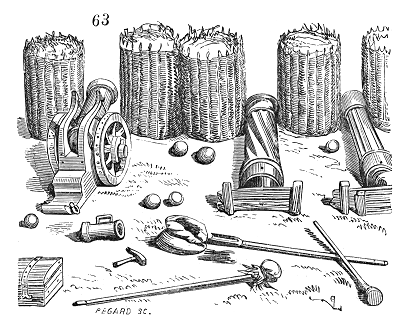
Fourth; a cannon requires a crew of four specialists to fire. A crew is payed 200gp a month, or 50gp a week. The payment is scaled so 50% goes to the artillery crew commander, 25% goes to the gunner, and the remaining amount is split among the two less specialized crew members.  Player character can be used in place, or a whole group of PCs can manage one cannon. But cleaning, reloading, and aiming takes the whole reload time which means those players can't do anything else if they are on cannon duty. Any crew attacked during the reload period doesn’t stop it from happening but any killed crew member (or anyone that leaves the cannon) adds an additional 2 rounds to the reload time. This can be worked around by placing barriers like gabions or mantlets to provide cover. If an artillery crew is attacked in close quarters they will fight back, but only as Normal Men. 


Fifth; Cannons are a pain to move, requiring at least two people to wheel them
around. Light cannons can be moved at 20ft per round and medium cannons can be moved 10ft per round and takes a full round to move them this distance. Cut this rate in half if there is one person wheeling it around. They can be moved at any point during their reload, but will delay the reload time if they are moved. Heavy cannons are NOT moved in combat rounds, since they are too large and heavy. Usually heavy cannons like bombards are planted on the ground in strategic positions. Moving a bombard requires at least 10 people and 4 beasts of burden to transport it, which also move at a wilderness rate equivalent to 6 miles a day.

Cannons, artillery crew tools and gabions

Optional rule: if a higher level character is hit and doesn’t die, it should result in a permanent disfigurement, such as losing a limb. Granted, maybe a cleric can reattach it with a cure wounds spell or grow a new one from the bloody stump with some magical aid over time.

The Dowel Rule: This is taken from Chainmail. Basically you have a dowel rod of a certain length that represents the attack range of the cannon. It is painted with different thickness black and white stripes to represent a cannon’s uneven flight trajectory. A player declares their target that they aim for color and chooses either black or white hoping that they will potentially hit their preferred target in the dowel’s color range they selected. Then they line up the dowel associated with the cannon and see who else is hit with it. Anyone within the line of the dowel that is in the color space chosen by the player is eliminated on a successful fire. So this means the cannon ball rips through people but also will miss some people based on its changing trajectory as it plows through soldier’s bodies. Wild! You also use an additional dowel with a 1-6 1½ inch measurements on it to determine the where the cannon actually ends up firing. Refer to the image taken directly from the chainmail rules to show the aiming dowel

This also means the color that was chosen is kept in the event of a miss and a new trajectory is determined. The dowel’s thickness also plays a part into the 3D attack of the cannon in Chainmail, so the bigger the cannon, the thicker the dowel. Anyone the dowel’s diameter touches is affected, which means some scrappy Halfling might have the cannon shoot right over their head! The following chart is directly lifted from Chainmail to create your own dowels.
Cannons are incredibly powerful, and are probably better left for the battlefield than in regular adventuring. However, players might come across one they can fire down a hallway in a castle they are raiding to blast open a door or to use as defense in their stronghold if/when they reach name level. So you never know when the availability of a cannon might pop up in a game and you KNOW someone at the table will be interested in using it. Cannons are after all the closest a player character will have to using a breath-like weapon without polymorphing into a dragon themselves.

Gunpowder Weapons in Your OSR Game Part One; Medieval Firearms

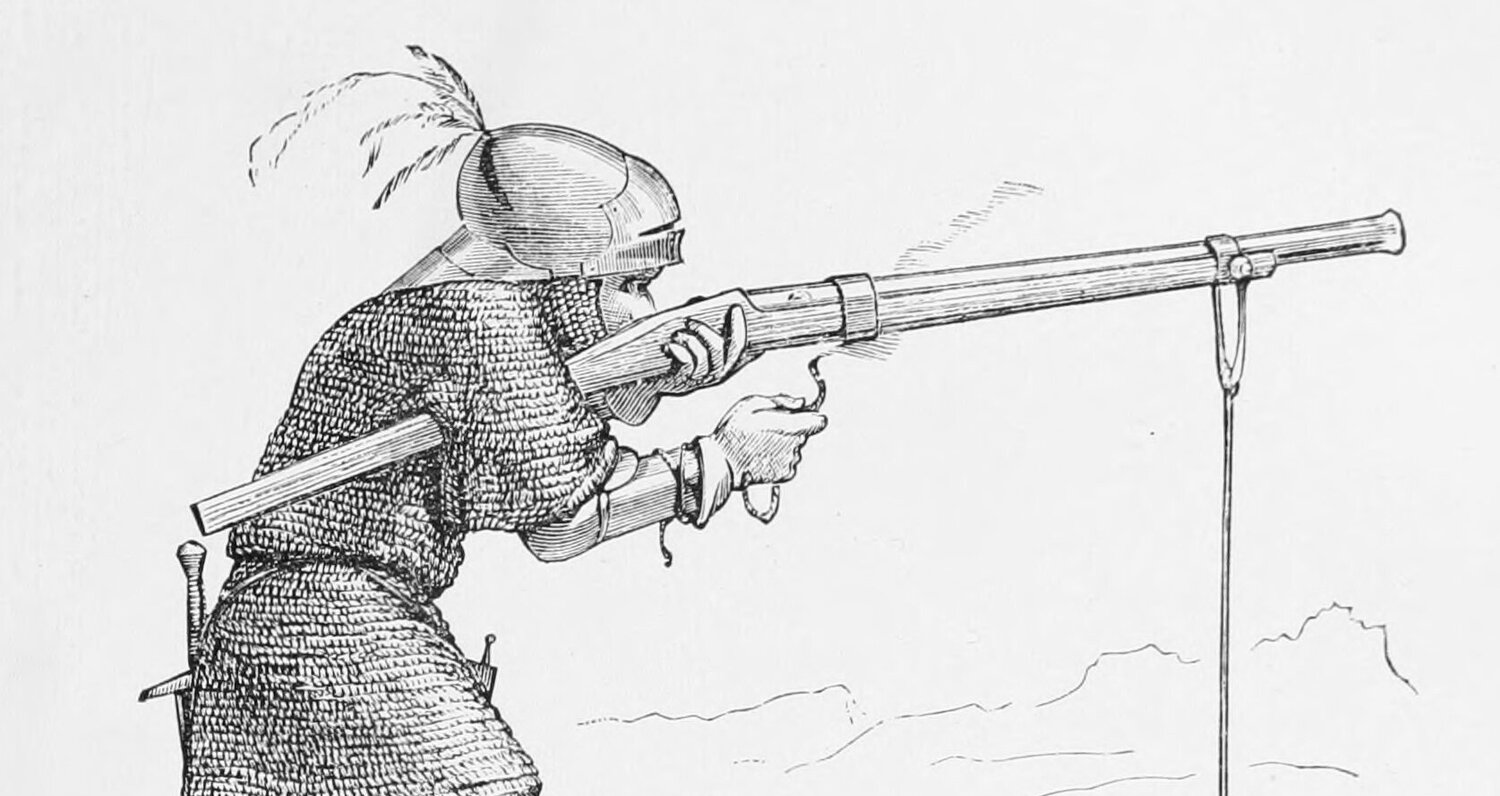
 This is a divisive topic, but here is my opinion: gunpowder weapons belongs in D&D. In my experiences, the discussion of gunpowder weaponry in D&D creates division amongst players, often weighted towards most players I’ve encountered being against them. The only other controversial idea that comes close is psionics (which are also cool.) However, I’d argue that the lack of inclusion of black powder weapons is rooted more in a misunderstood mishmash of medieval tropes that players collectively buy into which usually excludes black powder weapons. This is ill-informed. At the very least, it seems that player believe that the inclusion firearms is anachronistic within their game since they associate the use of firearms as something from the renaissance which they often see as separate from the late middle ages and not a regional intellectual shift during the late middles ages into the early modern period. Firearms didn’t enter the European battlefield until the late middles ages in the 1300s by way of China through the Middle East before then in the 1200s. Even with the inclusion of black powder into the battlefield in the 1300s, it was known about and discussed before then. Roger Bacon wrote about it in his Opus Majus in 1267. Some people could argue to have a historical line that they don’t want to cross as their aesthetic influence from the middle ages as a way to cut out firearms. Okay sure, but I find this funny because we gladly accept other late medieval advancements in D&D such as plate armor or all of those polearms Gygax shoved into the back of Unearthed Arcana. While, yes this is late into the 1000 year span of the Middle Ages, it is this period that informs most of our popular knowledge of the middle ages. In fact, it seems like most of the medieval knowledge that players have or used as a reference is from the 1200-1500 range of High to Late Middle Ages; a time where firearms were emerging and being used. 


Anyways, Gunpowder weapons has a basis within the core D&D games. Chainmail has “arquibusiers,” Dragon Magazine introduces overly explained and nitpicky firearm rules in Dragon #70, and you can see their inclusion in the d20 systems and beyond. But no one uses them! While Gygax would encourage you chose what to include in your “milieu”, he’d probably also mention how in Zelazny’s Amber series that gunpowder doesn’t ignite in that pseudo-medieval fantasy setting as a possible rationale for players who protest their inclusion. Okay cool, but Gygax also bulked out his AD&D rules with unnecessary filler that are baseless in real life/made up to fill a page that has since caused a mandala effect amongst players to create the illusion of variety but are overall meaningless bloat. For example: Broadswords and Splint Mail aren’t real and never have been, they are Victorian neologisms. Also, why did Gygax list all armor as “mail” in his DMG? Anyways, while I ground my personal take on D&D by attempting to be informed of the past and use it for inspiration, I think it’s illogical to argue in favor of one and against the other. It’s an arbitrary line that people just seem to stake their feet in the sand over simply because they have NO knowledge of Western Europe’s medieval era EXCEPT from D&D, video games, movies/tv and other popular media. Which is a shame. I hope people become more interested in researching history over prioritizing their misguided assumptions of the past. I guess what I’m trying to say is: If you have plate armor then why not handgonnes or cannons?


Firearms:
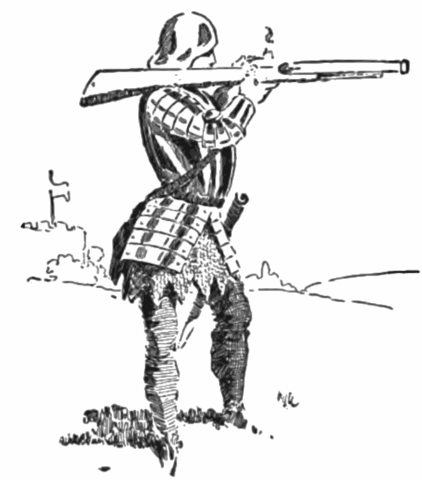
I’ll keep it pretty simple to help with the inclusion of these weapons. They should be different from bows and crossbows and provide more extreme pro/con rationale to help give them a distinct flavor. I’m also partial to the inclusion of additional effects that they provide beyond simple damage since combustion is a variable that should be considered. Generally, Handgonnes are basically poles with a small cannon attached to the end. These poles can range from a few feet long to more like a polearm in length. In addition, there is historical record for a scattershot handgonne. Handgonnes developed into the arquebus, which were more advanced and easier to use. So I’ll work with these options.

Handgonne: 100gp, 1d12 damage w/ bullet, 1d8 as a bludgeon. Range is same as a bow. Note: as a bludgeoning attack, apply a -2 to the attack roll since it is unwieldly.


Arquebus: 200gp, 1d12 damage/ w bullet, 1d6 as a bludgeon. Range is same as a crossbow

Scattershot Handgonne: 150gp, 1d4 per bullet, 1d8 as a bludgeon (-2 to attack). Causes a cone attack, same as a dragons (80ft long, 30ft wide on far end.) 20 close range, 20-60 medium, 60-80 long range. Fires ten shots simultaneously. Anyone closest to the attack is hit on a successful attack roll, misses don’t go past the initial group of close targets. Divide 10d4 equally (rounding down) among the closest targets in range, while subtracting the ones that missed.

Ex: A player firing a scattershot volley into a group of charging enemies rolls a 16 on their attack. There are four potential targets that are closest within the cone’s range. Their AC is 13, 13, 15, and 17. That would round down to 2d4 per target. Remove the target with 17 AC, causing 2d4 each to the remaining three targets.

Why d12 for damage? Well, a couple reasons: 1) I feel like the larger range is better reflective of the variable accuracy of these early firearms, where they could graze someone or blast a hole in them. This also seems to line up well with the increased scaling of ranged weapon output without needing to roll two dice. I’m not into rolling two dice for a single attack because I personally I don’t think early firearms should have a bell curve for damage, so d12 lines up well with my rationale. 2) I have a soft-spot for the d12, where I feel like it rarely is used and it deserves more opportunities to be rolled.

Additional gunpowder rules to use if you desire:

  • It is assumed all weapons are loaded and ready to fire at the beginning of combat
  • Takes 3 uninterrupted rounds to reload. Any attack that hits them would cause them to save vs. Paralysis to continue uninterrupted otherwise they waste the black powder and have to start over
  • Firing the weapon causes a save vs. petrify amongst animals and non-intelligent monsters within 30ft of the weapon to keep them from running off. Trained horses used by anyone with 2HD or higher are unphased
  • A plume of smoke is created in a 5 foot space in front of the shooter that drifts away in one round. This plume provides -2 to any ranged attacks as partial cover.
  • Anyone hit with the force of a black powder weapon is knocked over on a failed save vs. Death Ray if they take 6+ damage. Firearms certainly would cause dents into well-made plate armor, and punch a whole into munitions grade armor. The impact of such a  blow would easily knock someone over. This included being dismounted from a mount as well. Anyone receiving full weapon damage from the Handgonne or Arquebus (12 points) has the bullet rip through them and hit the next closest target behind them if any (save vs. Death Ray to avoid)
  • For any missed shots from the Handgonne or Arquebus, I use the “grenade-like Missiles” chart on page 47 of the Basic Fantasy rulebook to determine where the bullet hits instead if the target is in a crowd.
  • Each bullet costs 5gp, each bottle of gunpowder is 120gp, with each shot costing 20gp; for a total of 6 shots per bottle. Can be used as an explosive grenade weapon for 1d6 per remaining shot within the bottle. Scattershot pellets are 10gp per volley, but uses the same amount of gunpowder.
  • Water causes black powder to be inert and not work.

 Overall, firearms are expensive and finicky, but can be extremely effective. Beyond its intended application, they can be representative of the potential a normal man to rival the offensive output of any trained magic-user which could have political effects within a setting.